

Water is one of the first questions people ask about Las Vegas growth.
Can the valley keep growing? Is Lake Mead a threat to real estate? Should buyers worry about long-term water supply? Are new homes still being approved? Is Las Vegas doing enough to conserve?
These are fair questions. They are also questions that deserve a more balanced answer than the extremes people often hear online.
Las Vegas is located in the Mojave Desert and depends heavily on the Colorado River system. That is a real constraint. At the same time, Southern Nevada has become one of the country's most watched examples of urban water conservation, recycling, and long-term resource planning.
For buyers, sellers, and investors, the truth is not "ignore water" and it is not "Las Vegas is doomed."
The truth is: water matters, and smart real estate decisions should understand the facts.
Where Las Vegas Gets Its Water
Southern Nevada receives most of its water from the Colorado River, delivered through Lake Mead. The Southern Nevada Water Authority manages regional planning, conservation, infrastructure, and long-term water resource strategy.
The Colorado River has faced long-term drought conditions, reduced flows, and complicated negotiations among Western states. Those issues are serious and will continue shaping water policy for years.
But Las Vegas is not passively waiting.
Southern Nevada has invested heavily in conservation, return-flow credits, infrastructure, lower intake systems, turf removal programs, water recycling, and planning for future shortage conditions.
That is why the water story in Las Vegas is more nuanced than many headlines suggest.
Conservation Has Changed The Growth Conversation
One of the most important facts about Las Vegas is that the region has grown while reducing overall water consumption compared with prior peaks.
That does not make water unlimited. It does show that policy and behavior matter.
Southern Nevada's conservation approach includes turf removal and limits on nonfunctional grass, water-efficient landscaping rules, indoor water recycling through return-flow systems, leak enforcement, golf course water budgets, and long-term resource planning.
For real estate, this means water policy is already built into how homes, communities, and commercial projects are designed.
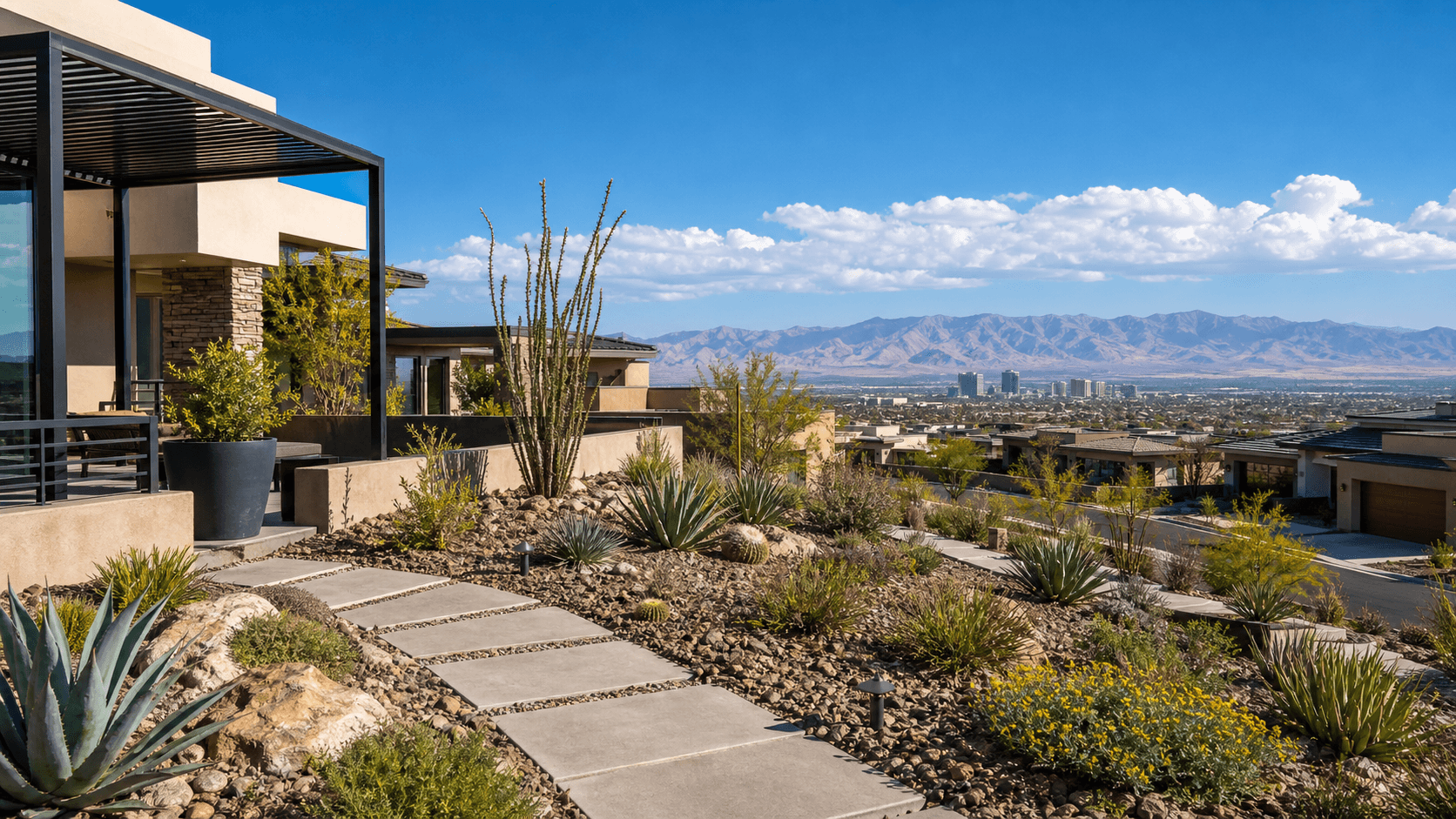
Newer communities often use desert landscaping, efficient irrigation, and water-conscious design because the rules require it and buyers increasingly expect it. This is especially visible in newer master-planned communities like Summerlin, Cadence, and Skye Canyon.
What Buyers Should Know About Landscaping
If you are relocating from California, the Pacific Northwest, the Midwest, or the East Coast, Las Vegas landscaping may look different from what you are used to.
Grass-heavy yards are less common in newer communities. Desert landscaping, synthetic turf, pavers, shade structures, drip irrigation, and low-water plants are more typical.
That affects monthly water bills, HOA rules, backyard design, resale appeal, maintenance expectations, and pool and spa decisions.
A lush lawn may sound appealing, but it may not be allowed, practical, or cost-effective in many communities. Buyers should review HOA guidelines, city rules, and water restrictions before planning major yard changes.
Pools Are Still Common, But They Need Context
Pools remain popular in Las Vegas, especially because of the long hot season. A pool can be a major lifestyle feature and may help resale in certain price ranges.
But buyers should understand the full cost.
Pool ownership can affect water use, electric bills, maintenance expenses, insurance, repair risk, safety considerations, and backyard usability.
In some homes, a pool is a major asset. In others, it can narrow the buyer pool or create unnecessary expense. The right answer depends on the neighborhood, price point, lot size, and buyer lifestyle.
The Horizon Lateral Pipeline And Infrastructure Redundancy
One of the important 2026 water infrastructure stories is the Horizon Lateral project, designed to provide additional transmission capacity and redundancy for parts of the valley.
Nevada officials have described the project as important for reliability, especially as parts of Southern Nevada continue to grow. The Sloan Canyon Conservation and Lateral Pipeline Act was supported as a way to allow a portion of the project to pass beneath Sloan Canyon National Conservation Area and improve water infrastructure reliability.
This kind of project does not mean Las Vegas suddenly has unlimited water. It means the region is investing in infrastructure so the delivery system can better serve existing and future demand.
For real estate, infrastructure reliability matters. Buyers often think about roads, schools, hospitals, and utilities. Water transmission capacity belongs in that same conversation.
Does Water Limit New Construction?
Water policy absolutely influences growth.
Developers, builders, planners, and local governments must account for water availability, infrastructure, conservation rules, and long-term planning.
But new construction has not stopped. Las Vegas, Henderson, and North Las Vegas continue to see activity in master-planned communities and growth corridors.
The better question is not, "Can Las Vegas build?"
The better question is, "Where can Las Vegas build responsibly, with the infrastructure and planning to support it?"
That is why water, land availability, transportation, utilities, and employment centers all need to be considered together. For a look at where that building is happening, see our guide to Las Vegas new construction communities in 2026.
What Sellers Should Know
Sellers should understand that some buyers, especially relocation buyers, may ask about water. A confident, informed answer can help.
Helpful seller talking points may include desert-efficient landscaping, low-maintenance yard design, drip irrigation, recent plumbing updates, pool efficiency upgrades, HOA landscaping compliance, smart irrigation controllers, and water-conscious improvements.
Avoid exaggerated claims. Buyers do not need a sales pitch. They need clear information.
If your home has efficient landscaping or lower-maintenance outdoor space, that can be a real advantage. If you want to know what your home is worth in the current market, get a home valuation.
What Investors Should Know
Investors should pay close attention to water because it affects operating costs, development assumptions, landscaping, tenant expectations, and long-term regulation.
For multifamily and commercial properties, water-related issues may include irrigation costs, cooling systems, landscape conversion opportunities, tenant utility structures, local compliance requirements, and capital improvements.
Water is not just an environmental topic. It is an operating topic.
Properties that are efficient, compliant, and easier to maintain may become more attractive over time.
The Lake Mead Question
Lake Mead levels are a major concern across the Southwest. Reduced Colorado River flows affect Nevada, Arizona, California, and other basin users.
For Las Vegas, the key point is that the city has invested in infrastructure to continue accessing water at lower lake levels, including deeper intake capability. That does not eliminate the broader Colorado River challenge, but it does make Las Vegas different from communities that have not planned as aggressively.
Buyers should understand both sides:
- Yes, long-term drought and Colorado River negotiations matter
- Yes, Southern Nevada depends heavily on Lake Mead
- Yes, conservation rules will continue to shape development
- No, the existence of drought does not mean every Las Vegas real estate decision is automatically unsafe
- No, online panic is not a substitute for local facts
The right approach is informed caution.
How Water Should Factor Into A Home Search
When buying in Las Vegas, water should be part of your due diligence, especially if outdoor space matters to you.
Ask what the HOA landscaping rules are, whether the yard is desert landscaped, whether irrigation is functioning properly, how old the pool equipment is, whether there are smart irrigation controls, and what typical utility costs look like.
These questions are practical. They help you understand the true cost of ownership.
If you are relocating from another state, our residential buyer resources can walk you through the full due-diligence process specific to Las Vegas.
The Bottom Line
Water is one of the most important long-term issues facing Las Vegas.
It should be taken seriously.
But Las Vegas is also one of the most proactive water-management regions in the country. The city has grown, conserved, invested, adapted, and planned in ways that many outsiders do not fully understand.
For real estate buyers and sellers, the best path is not panic. It is clarity.
Understand the rules. Understand the costs. Understand the infrastructure. Understand the neighborhood. Then make a decision based on the full picture.
Thinking About Buying Or Selling In Las Vegas?
If you are relocating to Las Vegas or trying to understand how growth, water, and local market trends affect your next move, VIEW VEGAS can help you evaluate the facts neighborhood by neighborhood.
The best real estate decisions in Las Vegas are local, informed, and grounded in how the valley actually works. Schedule a consultation to get started.
Sources And Further Reading
- Southern Nevada Water Authority, 2026 Water Resource Plan
- Southern Nevada Water Authority, Drought and Shortage information
- Nevada Governor's Office, Sloan Canyon Conservation and Lateral Pipeline Act release, February 2026
- Western Water, "Las Vegas water backup plan becomes law," May 2026
- LVCVA and regional economic context reporting
Frequently Asked Questions
Where does Las Vegas get its water?
Southern Nevada receives most of its water from the Colorado River, delivered through Lake Mead. The Southern Nevada Water Authority manages regional planning, conservation, infrastructure, and long-term resource strategy.
Is Las Vegas running out of water?
Las Vegas has grown while actually reducing overall water consumption compared to prior peaks — largely through aggressive conservation, return-flow credits, and infrastructure investment. Water constraints are real, but Las Vegas is one of the most proactive water-management regions in the country.
Can you still have a pool in Las Vegas?
Yes. Pools remain popular and can be a major lifestyle and resale feature. Buyers should understand the full cost including water use, electric bills, maintenance expenses, and insurance.
Does water policy affect new construction in Las Vegas?
Yes. Developers and builders must account for water availability and conservation rules. Newer communities are designed with desert landscaping, efficient irrigation, and water-conscious systems. New construction has not stopped, but it is guided by responsible planning.
What should buyers ask about water when buying a home in Las Vegas?
Ask about HOA landscaping rules, whether the yard is desert landscaped, irrigation functionality, pool equipment age, smart irrigation controls, and typical utility costs. These are practical due-diligence questions, not fear-based ones.
Want the Las Vegas market read each month?
Pricing, inventory, and what's actually moving — written by brokers working the market, not recycled national headlines. Tell us which side you care about.