

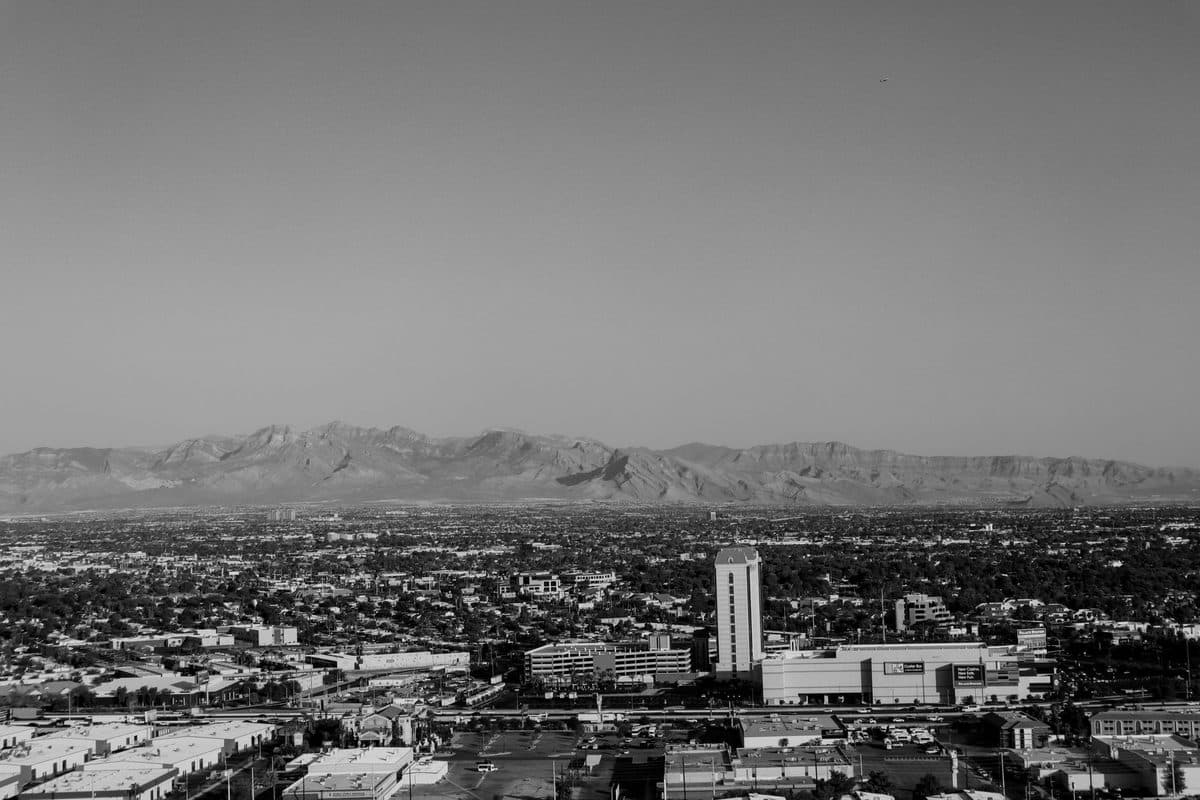
Las Vegas commercial real estate in mid-2026 is a market digesting a building boom rather than reacting to a downturn. Industrial vacancy sits near 9.0% with 825,000 SF of positive net absorption in Q2 (Source: CBRE Las Vegas Industrial Figures · Q2 2026). Office vacancy fell to 11.9%, its fourth consecutive quarterly decline and the first sub-12% reading since Q4 2023 (Source: CBRE Las Vegas Office Figures · Q2 2026). Retail is the tightest asset class in the valley at 5.4% vacancy (Source: Avison Young via Nevada Business Magazine · July 2026). The valley-wide numbers, though, are close to useless on their own—North Las Vegas and the Southwest are effectively two different markets right now. Here is where each asset class actually stands.
Las Vegas Commercial Market at a Glance (Q2 2026)
| Asset class | Vacancy | Asking rent | Recent absorption |
|---|---|---|---|
| Industrial | ~9.0% (+20 bps QoQ) | — | +825,000 SF (Q2) |
| Office | 11.9% (−80 bps YoY) | $2.56/SF/mo FSG | +177,000 SF (YTD) |
| Retail | 5.4% (stable) | $36.90/SF/yr | ~1.4M SF under construction |
Sources: CBRE Las Vegas Industrial Figures and Office Figures, Q2 2026; Avison Young via Nevada Business Magazine, July 2026.
Industrial: The Supply Wave Has Landed, and the Valley Is Eating It
Southern Nevada's industrial base is roughly 188.9 million SF, and about 8 million SF of that was delivered in the last 18 to 24 months—which is exactly why vacancy climbed from a scarcely believable 1.3% in 2022 to a 10.1% peak in Q3 2025 (Source: Colliers' Jerry Doty via Las Vegas Review-Journal · July 2026). That was a supply story, not a demand collapse.
The digestion is now visible. CBRE recorded 825,000 SF of positive net absorption in Q2 2026 against roughly 1.3 million SF of new deliveries, with vacancy ticking up just 20 basis points to about 9.0% and roughly 5.9 million SF still under construction (Source: CBRE · Q2 2026). Nearly three-quarters of that positive absorption landed in North Las Vegas—the same submarket carrying the highest vacancy, which tells you tenants are signing where the space and the concessions are.
The submarket spread is the number that should drive your decision:
- North Las Vegas — 10.7% vacancy on 78.2 million SF of inventory. The valley's big-box distribution engine, and its loosest submarket.
- Southwest Las Vegas — 6.2% vacancy, with +530,270 SF of net absorption in Q1 2026 while North Las Vegas posted −591,201 SF in the same quarter.
- Apex — roughly 19.3 million SF of planned product, and the other submarket CBRE flags for elevated vacancy. Long-horizon land play, not a today lease.
(Source for submarket figures: Colliers via Las Vegas Review-Journal · July 2026.)
Two details matter more than the headline vacancy rate. First, local companies account for 43.3% of leased square footage, and median deal sizes run about 5,421 SF in the Southwest and 5,539 SF in East Henderson—this is a small-tenant market wearing big-box clothing. Second, zero new deliveries are scheduled for Q1 2027. A pipeline that empties while absorption stays positive is how a 9% market becomes a 7% market. Our Las Vegas industrial market report goes deeper on rates and the industrial leasing and sales page covers how we run those deals.
Office: Four Straight Quarters of Falling Vacancy, Flat Rents
Office is the quiet turnaround. Vacancy fell to 11.9% in Q2 2026, down 20 bps from 12.1% in Q1 and 80 bps below the 12.7% posted a year earlier—the first sub-12% reading since Q4 2023 (Source: CBRE · Q2 2026). First-half net absorption reached roughly 177,000 SF, one of the stronger opening halves in recent years, though Q2 alone contributed only about 8,000 SF of that.
Average asking rates held at $2.56 per SF per month, full-service gross, essentially unchanged. That combination—falling vacancy, flat rents—is what a recovery looks like before landlords regain pricing power. Limited new supply is doing much of the work, along with tenants trading up into better buildings. For occupiers in the Southwest corridor and around Harry Reid International, the window for negotiating aggressive terms in Class A space is narrowing faster than the valley average suggests. Our Las Vegas office market guide breaks down the submarket splits.
Retail: The Tightest Asset Class in the Valley
Retail vacancy held at 5.4% with average asking rents at $36.90 per SF and roughly 1.4 million SF under construction, including retail tied to the future MLB ballpark, Hylo Park, The Bend, and the Regal redevelopment in Summerlin (Source: Avison Young's Hillary Steinberg via Nevada Business Magazine · July 2026).
The behavioral shift matters as much as the rate: retailers are chasing newly constructed, first-generation space over older shopping centers, and following multifamily development into emerging corridors. Practically, that means a 1998 strip center in an established neighborhood competes on price, while a shell going up next to new rooftops leases at ask. If you are hunting space, our Las Vegas retail leasing guide covers the submarket-by-submarket picture.
What the 2026 Growth Forecast Changes for Investors
This is the piece most 2026 market roundups have not updated for. In July 2026, UNLV's Center for Business and Economic Research revised its long-term outlook: Clark County sits near 2,505,000 residents, adds roughly 17,000 jobs in 2026 and 20,000 in 2027, and about 117,000 jobs between 2026 and 2036—but the annual growth rate slides from 1.6% in 2026 to 0.6% by 2029, pushing the 3-million-resident milestone out to 2055 (Source: UNLV CBER 2026 Population Forecast via Las Vegas Review-Journal · July 2026). Transportation and warehousing ranks among the top three job-growth categories, which is a direct tailwind for industrial demand.
Read that correctly. Demand still grows—it just grows slower, which means a building's own fundamentals have to carry it. In a 1.3%-vacancy market, location errors got bailed out by scarcity. At 9%, they do not. Meanwhile the demand-side catalysts are real and dated: the Athletics' $2 billion, 33,000-seat domed ballpark on the Strip has completed foundation work and remains targeted to open before the 2028 season, with about $300 million spent so far (Source: Las Vegas Sun · February 19, 2026).
What This Means If You Are Leasing, Buying, or Selling
Tenants: Your leverage is submarket-specific, not market-wide. North Las Vegas and Apex still have slack; the Southwest and Airport do not. Sign longer where the pipeline goes dry in 2027.
Buyers and investors: Positive absorption against an emptying construction pipeline is the setup you want to be early on. Underwrite to submarket vacancy, not the valley average, and see our Las Vegas cap rate breakdown for current yield by asset class and our investment services for deal support.
Owners and sellers: Retail owners hold the strongest hand in the valley. Industrial owners in the Southwest are in good shape; North Las Vegas owners should expect to compete on concessions until the 2027 supply gap arrives.
Published vacancy figures differ modestly between brokerages—each firm tracks a slightly different building set—so compare the trend and the submarket detail rather than treating any single decimal as gospel.
Frequently Asked Questions
What is the Las Vegas industrial vacancy rate in 2026? Valley-wide industrial vacancy was approximately 9.0% in Q2 2026, up 20 basis points from Q1 (Source: CBRE Las Vegas Industrial Figures, Q2 2026). That average hides a wide spread: Colliers data reported in July 2026 put North Las Vegas at 10.7% and the Southwest at 6.2%.
Is 2026 a good time to buy commercial real estate in Las Vegas? It is a better time to buy than 2024 was, because the supply wave that pushed vacancy from 1.3% in 2022 to a 10.1% peak in Q3 2025 has largely delivered and is now being absorbed (Source: Colliers via Las Vegas Review-Journal, July 2026). Buyers still have negotiating leverage in North Las Vegas and Apex; the Southwest and Airport submarkets have already tightened.
Which Las Vegas submarket has the lowest industrial vacancy? The Southwest, at 6.2% as of Colliers data reported in July 2026—roughly 4.5 points tighter than North Las Vegas. CBRE also identifies the Airport and Southwest submarkets as the valley's tightest in its Q2 2026 report.
Are Las Vegas office rents rising in 2026? Rents are flat, not rising. Average asking rates held at $2.56 per SF per month full-service gross in Q2 2026, essentially unchanged from recent quarters, even as vacancy fell for a fourth straight quarter to 11.9% (Source: CBRE Las Vegas Office Figures, Q2 2026).
Why is retail space so hard to find in Las Vegas? Retail is the valley's tightest asset class at 5.4% vacancy with average asking rents of $36.90 per SF, and only about 1.4 million SF is under construction (Source: Avison Young via Nevada Business Magazine, July 2026). Tenants are chasing first-generation space near new rooftops, so the newest centers lease before older ones do.
Does slower population growth hurt Las Vegas commercial real estate? It changes the math without breaking it. UNLV's Center for Business and Economic Research now projects Clark County adds about 17,000 jobs in 2026 and 117,000 through 2036, with growth easing from 1.6% to 0.6% annually by 2029 (Source: UNLV CBER 2026 Population Forecast, July 2026). Demand still grows—it just no longer bails out a badly chosen building.
Frequently Asked Questions
What is the Las Vegas industrial vacancy rate in 2026?
Valley-wide industrial vacancy was approximately 9.0% in Q2 2026, up 20 basis points from Q1 (Source: CBRE Las Vegas Industrial Figures, Q2 2026). That average hides a wide spread: Colliers data reported in July 2026 put North Las Vegas at 10.7% and the Southwest at 6.2%.
Is 2026 a good time to buy commercial real estate in Las Vegas?
It is a better time to buy than 2024 was, because the supply wave that pushed vacancy from 1.3% in 2022 to a 10.1% peak in Q3 2025 has largely delivered and is now being absorbed (Source: Colliers via Las Vegas Review-Journal, July 2026). Buyers still have negotiating leverage in North Las Vegas and Apex; the Southwest and Airport submarkets have already tightened.
Which Las Vegas submarket has the lowest industrial vacancy?
The Southwest, at 6.2% as of Colliers data reported in July 2026—roughly 4.5 points tighter than North Las Vegas. CBRE also identifies the Airport and Southwest submarkets as the valley's tightest in its Q2 2026 report.
Are Las Vegas office rents rising in 2026?
Rents are flat, not rising. Average asking rates held at $2.56 per SF per month full-service gross in Q2 2026, essentially unchanged from recent quarters, even as vacancy fell for a fourth straight quarter to 11.9% (Source: CBRE Las Vegas Office Figures, Q2 2026).
Why is retail space so hard to find in Las Vegas?
Retail is the valley's tightest asset class at 5.4% vacancy with average asking rents of $36.90 per SF, and only about 1.4 million SF is under construction (Source: Avison Young via Nevada Business Magazine, July 2026). Tenants are chasing first-generation space near new rooftops, so the newest centers lease before older ones do.
Does slower population growth hurt Las Vegas commercial real estate?
It changes the math without breaking it. UNLV's Center for Business and Economic Research now projects Clark County adds about 17,000 jobs in 2026 and 117,000 through 2036, with growth easing from 1.6% to 0.6% annually by 2029 (Source: UNLV CBER 2026 Population Forecast, July 2026). Demand still grows—it just no longer bails out a badly chosen building.
Looking for space, or a commercial deal?
Tell us the size, use, and submarket. We'll send current availabilities and real quoted rates — including the ones that never hit a public listing site.