

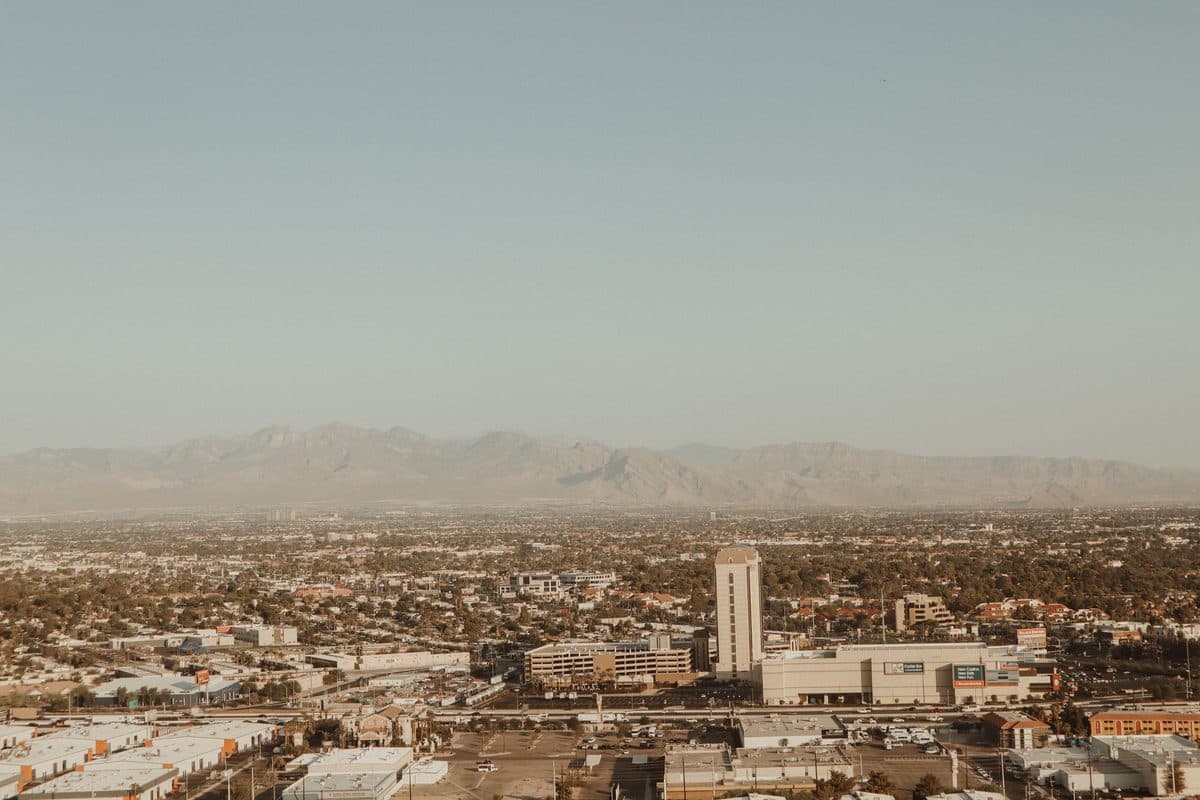
Las Vegas commercial real estate cap rates in 2026 range from roughly 5.0% for investment-grade NNN retail up to 9.0%+ for distressed office, with industrial and multifamily sitting in the 5.5–7.5% middle ground. The city's zero state income tax effectively adds 100–130 basis points of after-tax yield versus California or Oregon-based alternatives—a real edge that rarely appears in national cap rate tables. Here is where yield actually lives in the valley right now, submarket by submarket.
Industrial: Where the Fundamentals Are Strongest
Las Vegas industrial is the valley's clearest story. After a heavy supply wave in 2023–2024, the market has absorbed its way back to health. Vacancy fell to 9.1% in Q2 2026, down from 9.4% in Q1, with net absorption of 762,000 SF in the quarter alone (Source: Colliers Q2 2026). Year-to-date absorption sits at 2.3 million SF.
Cap rates by submarket:
| Submarket | Cap Rate Range | Avg Asking Rent (NNN/mo) |
|---|---|---|
| Southwest LV (I-15/215) | 5.5%–6.5% | $1.42–$1.67/SF |
| Henderson | 6.0%–7.0% | $1.15–$1.35/SF |
| North Las Vegas | 6.5%–7.5% | $0.85–$1.16/SF |
| Airport/Eastside | 6.0%–7.0% | $1.10–$1.20/SF |
Southwest Las Vegas commands the tightest cap rates because owner-user demand is strongest there—small- and mid-bay product under 30,000 SF routinely sells at $300–$368/SF. North Las Vegas runs wider because a larger sublease overhang (~2.6M SF market-wide per Alignment CRE) gives buyers more negotiating room.
For sale-leaseback and owner-user acquisitions via SBA 504 (10% down), industrial remains Ryan Mote's highest-conviction asset class at ViewVegasNow Commercial. Amazon's $124M acquisition of a North Las Vegas bulk facility in early 2026 (Source: Hoodline, April 2026) validated institutional appetite for the submarket even as smaller deals trade at a premium.
NNN Retail: Stable Income, Tight Spreads
Single-tenant NNN assets—QSR pads, pharmacy strips, dollar stores—are the go-to trade for 1031 exchange buyers rolling California gains into Nevada. Clark County retail vacancy sits at 4.5%, the tightest of any major asset class, with average asking rents reaching a record $2.12/SF NNN in Q2 2026 (Source: Colliers Q2 2026).
Cap rate context:
- Investment-grade NNN (Starbucks, Chase, Walgreens, McDonald's): 5.0%–6.0%
- Multi-tenant strip/neighborhood center: 6.5%–7.5%
- Regional NNN average (Q1 2026): 6.80% (Source: Neuhaus Realty Q1 2026)
The best corridor plays are the Flamingo/Sahara Strip-adjacent pads, Summerlin's 215 freeway frontage, Henderson's Green Valley/St. Rose Parkway intersection, and the Craig/Losee retail node in North Las Vegas. Each of these corridors benefits from captive rooftops in the 50,000–80,000-resident catchment range.
For 1031 buyers on a 45-day clock, NNN retail is often the fastest close—credit tenants, clean titles, no management hassle. Explore commercial investment options or talk to our commercial team about current listings.
Multifamily: Compression Trend, Watch Vacancy
Las Vegas multifamily has stabilized after a rent correction in 2024. Operations are improving and sale prices have moved off their lows (Source: Colliers Q1 2026 Multifamily Report). Southern Nevada multifamily vacancy measured 5.9% in Q1 2026, 0.6 points tighter than a year prior.
Cap rate benchmarks:
- Class A (new construction, Summerlin/Henderson): 4.5%–5.5%
- Class B (stable, 1990s–2010s vintage): 5.5%–6.5%
- Class C (value-add, North LV/Eastside): 6.5%–8.0%+
Nevada's zero state income tax sharpens the after-tax return picture. A 5.4% gross cap rate in Las Vegas nets out better than a 5.8% gross cap rate in Tampa (0.9% property tax) or Charlotte (4.5% state income tax) on an apples-to-apples after-tax comparison (Source: Nevada Real Estate Group / IPA Q1 2026).
The primary risk here is new supply: approximately 3,200 units delivered in 2024 and another 2,800 projected through 2026, which will keep vacancy from dropping below 5% near-term. Stick to 1998–2015 vintage assets in Henderson or the Centennial Hills submarket where submarket rents held best through the correction.
Office: Wide Caps Reflect Structural Uncertainty
Las Vegas office is the market's most nuanced play. Overall vacancy fell to 10.8% in Q2 2026—the best reading since 2019 (Source: Colliers Q2 2026)—but the headline masks a wide bifurcation.
Class A suburban office in Summerlin (Hughes Center, Beltway Business Park) is absorbing well. Absorption hit 512,774 SF in Q2—the strongest quarter since 2017. Conversely, Class B/C space downtown and in older Henderson corridors is repricing hard.
Cap rate ranges:
- Class A suburban (Summerlin, Green Valley): 6.0%–7.5%
- Medical office (Henderson, Centennial Hills): 6.5%–7.5%
- Class B suburban: 8.0%–9.5%
- Class C / downtown: 9.0%–11%+
The opportunity here is medical office. Healthcare employment in Clark County has grown steadily alongside population, and 2025–2026 saw new hospital anchor expansions at St. Rose Dominican (Henderson) and Valley Health System (Summerlin). Medical office is recession-resistant in ways standard office is not.
Where the Smart Money Is Going in 2026
To compare across asset classes directly:
| Asset Class | Cap Rate (LV, 2026) | Vacancy | Rent Trend | Best Submarket |
|---|---|---|---|---|
| Industrial | 5.5%–7.5% | 9.1% | +3% YoY | SW Las Vegas |
| NNN Retail | 5.0%–7.5% | 4.5% | +5% YoY | 215 corridor, Green Valley |
| Multifamily | 4.5%–8.0% | 5.9% | Stabilizing | Henderson, Centennial Hills |
| Class A Office | 6.0%–7.5% | 10.8% | Recovering | Summerlin, Hughes Center |
| Class B/C Office | 8.0%–11%+ | 14%+ | Declining | Avoid unless deep value-add |
Industrial and NNN retail are the two highest-conviction plays for investors who want yield without a major repositioning thesis. Multifamily is the better long-run compounding play if you can underwrite to a 5-year hold and own into the next supply trough.
The Nevada Tax Advantage: What It Actually Means for Cap Rate Math
The number that rarely shows up in national cap rate surveys: Nevada has no state income tax and no state capital gains tax. For a California investor, the delta is stark. A $500,000 capital gain from a California sale incurs $66,500 in California state tax at 13.3%. Rolling that gain via 1031 exchange into a Las Vegas commercial property defers both federal and state tax—then the ongoing rental income operates in a zero-state-income-tax environment.
At a $1M purchase, the difference between a 6.5% gross cap rate in Las Vegas and a 6.5% gross cap rate in a California submarket runs to roughly $9,750 per year in state income tax savings alone—equivalent to a 40–50 basis point cap rate improvement (Source: realized1031.com, IRS Publication 550). Over a 5-year hold with 3% annual rent bumps, that compounds to a material portfolio-level difference.
For 1031 exchange timelines: you have 45 days from close of sale to identify replacement properties and 180 days to close. Las Vegas NNN retail and industrial are two of the fastest asset classes to close cleanly—both see shorter average marketing periods than office or multifamily. See our commercial listings and investment advisory.
Frequently Asked Questions
What is the average cap rate for commercial real estate in Las Vegas in 2026? Las Vegas commercial properties average roughly 6.2–6.8% across asset classes, led by NNN retail (5.0–6.5%) and industrial (5.5–7.0%). The exact rate depends heavily on asset class, location, and lease quality.
Are Las Vegas cap rates competitive with other Sun Belt markets in 2026? Yes. Las Vegas industrial and NNN assets trade at comparable or tighter cap rates than Phoenix and Denver, and Nevada's zero state income tax adds roughly 100–130 basis points of effective after-tax yield advantage for California and Oregon investors.
Which Las Vegas submarket has the tightest industrial cap rates? Southwest Las Vegas (near the I-15/215 interchange) commands the tightest industrial cap rates—roughly 5.5–6.5%—due to high owner-user demand and limited supply. North Las Vegas runs slightly higher at 6.5–7.5% with more value-add opportunity.
What cap rate should I expect on a Las Vegas NNN property in 2026? Investment-grade, single-tenant NNN assets (QSR, pharmacy, dollar stores) are trading at 5.0–6.0% cap rates in Las Vegas. Multi-tenant NNN strip centers are in the 6.5–7.5% range. Neuhaus Realty reported a regional NNN average of 6.80% in Q1 2026.
Is a 1031 exchange into Las Vegas commercial real estate a good move in 2026? For California sellers, it often is. Nevada has no state capital gains or income tax, so rolling gains from a CA sale into LV commercial real estate can save an investor $50,000–$130,000+ in state taxes on a $500K gain, while landing in a market with improving fundamentals.
What Las Vegas commercial asset class offers the best risk-adjusted return in 2026? Industrial remains the strongest risk-adjusted play: vacancy fell to 9.1% in Q2 2026 (Colliers), absorption was positive for the fifth straight quarter, and the pipeline is 80% preleased. NNN retail is also compelling for investors prioritizing income stability over upside.

Frequently Asked Questions
What is the average cap rate for commercial real estate in Las Vegas in 2026?
Las Vegas commercial properties average roughly 6.2–6.8% across asset classes, led by NNN retail (5.0–6.5%) and industrial (5.5–7.0%). The exact rate depends heavily on asset class, location, and lease quality.
Are Las Vegas cap rates competitive with other Sun Belt markets in 2026?
Yes. Las Vegas industrial and NNN assets trade at comparable or tighter cap rates than Phoenix and Denver, and Nevada's zero state income tax adds roughly 100–130 basis points of effective after-tax yield advantage for California and Oregon investors.
Which Las Vegas submarket has the tightest industrial cap rates?
Southwest Las Vegas (near the I-15/215 interchange) commands the tightest industrial cap rates—roughly 5.5–6.5%—due to high owner-user demand and limited supply. North Las Vegas runs slightly higher at 6.5–7.5% with more value-add opportunity.
What cap rate should I expect on a Las Vegas NNN property in 2026?
Investment-grade, single-tenant NNN assets (QSR, pharmacy, dollar stores) are trading at 5.0–6.0% cap rates in Las Vegas. Multi-tenant NNN strip centers are in the 6.5–7.5% range. Neuhaus Realty reported a regional NNN average of 6.80% in Q1 2026.
Is a 1031 exchange into Las Vegas commercial real estate a good move in 2026?
For California sellers, it often is. Nevada has no state capital gains or income tax, so rolling gains from a CA sale into LV commercial real estate can save an investor $50,000–$130,000+ in state taxes on a $500K gain, while landing in a market with improving fundamentals.
What Las Vegas commercial asset class offers the best risk-adjusted return in 2026?
Industrial remains the strongest risk-adjusted play: vacancy fell to 9.1% in Q2 2026 (Colliers), absorption was positive for the fifth straight quarter, and the pipeline is 80% preleased. NNN retail is also compelling for investors prioritizing income stability over upside.
Looking for space, or a commercial deal?
Tell us the size, use, and submarket. We'll send current availabilities and real quoted rates — including the ones that never hit a public listing site.